8 Best Mailchimp Alternatives in 2026 (Prices Verified)
✓ Written by a human: a real person verified every number on this page against the vendor's own pricing page and signs off on every update. AI helps with the drafting. How we compare.
Mailchimp works, right up until the bill grows faster than the list. The free plan now stops at 250 contacts and 500 sends a month, automation on the Essentials plan caps out at four steps, and anyone selling to their audience still needs a stack of extra tools. Below are 8 alternatives compared on the numbers that matter, plus one bonus pick, with every price checked against the vendor's own pricing page in July 2026.
How we compared
Every price, plan limit, and feature call on this page comes from the vendors' own public pricing pages, all accessed on 11 July 2026 (the full list is in Sources). All prices are USD; where a vendor localizes prices we used their USD setting, and because Mailchimp only showed us local currency, we describe its limits and link to its pricing page rather than quote a converted number. Omnisend was running a 30% introductory discount when we checked, so we list both figures. The stars in the table are our editorial score: they weigh free-plan generosity, price at around 1,000 subscribers, automation depth, and how much the platform helps you earn from a list. G2 ratings are quoted separately in each review. When a vendor doesn't publish a number, we say so and link out instead of guessing. On 12 July 2026 we re-verified every price and added the cost-at-scale table below, using each vendor's monthly-billing price unless noted. We did not run deliverability tests; for inbox-placement data you'll want a source that sends real campaigns. Spotted something outdated? Tell us.
Quick comparison
| Overall rating (features, UX) | ⭐⭐⭐⭐⭐ | ⭐⭐⭐⭐ | ⭐⭐⭐⭐ | ⭐⭐⭐⭐ | ⭐⭐⭐ | ⭐⭐⭐ | ⭐⭐⭐ | ⭐⭐⭐ |
| Getting started free | ||||||||
| Free plan (not just a trial) | ✓ | ✓ | ✓ | ✕ | ✓ | ✓ | ✕ | ✕ |
| 1,000+ subscribers on the free plan | ✓ | ✕ | ✓ | ✕ | ✕ | ✕ | ✕ | ✕ |
| Unlimited sends on the free plan | ✓ | ✕ | ✕ | ✕ | ✕ | ✕ | ✕ | ✕ |
| Email & automation | ||||||||
| Landing pages & signup forms | ✓ | ✓ | ✓ | ✓ | ✓ | ✓ | ✓ | ✓ |
| Unlimited automations on the entry paid plan | ✓ | ✕ | ✕ | ✕ | ✓ | ✓ | ✕ | ✓ |
| Earning from your list | ||||||||
| Sell digital products built in | ✓ | ✓ | ✕ | ✕ | ✕ | ✕ | ✓ | ✕ |
| Paid newsletter subscriptions | ✓ | ✓ | ✕ | ✕ | ✕ | ✕ | ✓ | ✕ |
| Cross-promotion network to grow your list | ✓ | ✕ | ✕ | ✕ | ✕ | ✕ | ✕ | ✕ |
| Sponsorship marketplace (earn from ads) | ✓ | ✕ | ✕ | ✕ | ✕ | ✕ | ✕ | ✕ |
| Beyond email | ||||||||
| SMS campaigns | ✓ | ✕ | ✓ | ✓ | ✓ | ✓ | ✕ | ✕ |
| WhatsApp campaigns | ✕ | ✕ | ✓ | ✓ | ✓ | ✕ | ✕ | ✕ |
| Purpose-built for ecommerce stores | ✕ | ✕ | ✕ | ✕ | ✓ | ✓ | ✕ | ✕ |
| Entry paid plan (USD, monthly) | $33 (1,000 subs) | $12 (500 subs) | $9 (5,000 emails/mo) | $15 (1,000 contacts) | $45 (1,001–1,500 profiles) | $16 (500 contacts) | $19 (1,000 contacts) | $9 (500 contacts) |
| Free plan sending cap | Unlimited | 2,500/mo | 300/day | — | 500/mo | 500/mo | — | — |








Jump to a tool:
- Kit: best overall for creators, newsletters, and anyone earning from their list
- MailerLite: best budget all-rounder with the friendliest editor
- Brevo: best when your list is huge but your sending volume is small
- ActiveCampaign: best for deep automation with a sales CRM attached
- Klaviyo: best for ecommerce stores with real revenue
- Omnisend: best store-focused pick on a small budget
- GetResponse: best if you run webinars or courses alongside email
- Moosend: cheapest way to get unlimited sends and automation
- beehiiv: newsletter-only platform with a big free tier (bonus)
How to choose a Mailchimp alternative
Five checks will eliminate most of this list for you before you open a single trial:
- Start with the free plan, because three of the eight don't have one. The caps on the rest run from 250 contacts (MailerLite, Klaviyo, Omnisend) up to 1,000 (Kit), or no published contact cap with a daily send cap (Brevo).
- Know what you're billed for: subscribers (Kit, MailerLite, Moosend), emails sent (Brevo), or active profiles (Klaviyo). A 20,000-contact list that emails monthly wants Brevo's model. A 1,000-subscriber list that sends daily wants anyone else's.
- Read the automation limits on the plan you'd actually buy, not the one in the demo. ActiveCampaign's Starter allows 5 actions per automation, GetResponse's Starter allows one workflow, and Mailchimp's Essentials stops at four flow steps.
- If you sell digital products or a paid newsletter, only Kit, MailerLite, and GetResponse handle it in-platform. Everyone else means bolting on Gumroad or Stripe.
- Count the channels you'll actually use. SMS and WhatsApp come standard in the ecommerce tools, as add-ons in the suites, and not at all in the budget picks. Don't pay for channels that pad a feature list.
One more thing most roundups skip: these tools sit in different layers of the email stack, and comparing across layers is how people end up overpaying.
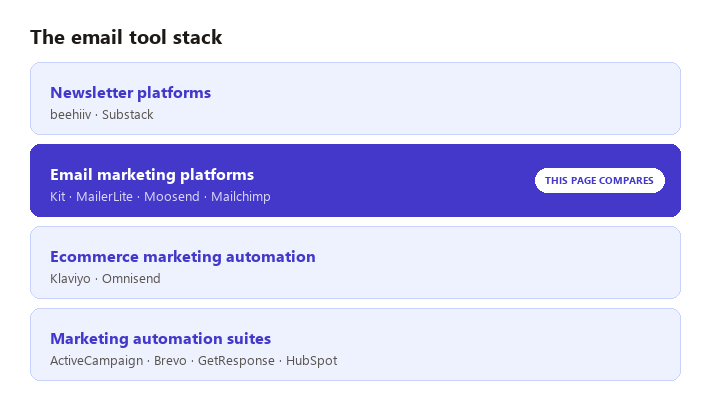
Newsletter platforms (beehiiv, Substack) publish and monetize one newsletter and nothing else. General email marketing platforms (Kit, MailerLite, Moosend, and Mailchimp itself) are the layer this page compares. Ecommerce marketing automation (Klaviyo, Omnisend) runs on store data and earns its cost only if you have a store. Marketing automation suites (ActiveCampaign, Brevo, GetResponse, and full CRM platforms like HubSpot) add CRM, multi-channel sends, and team features. HubSpot's free tools include email marketing capped at 2,000 sends a month, which is enough to test the suite layer without paying. The table above mixes the middle layers because real shortlists do, but don't judge a suite's price against a newsletter tool's without noticing the layer.
What they cost as your list grows
Here is each tool's entry paid plan at three list sizes, monthly billing unless noted, checked 12 July 2026:
| Tool | 1,000 subs | 5,000 subs | 25,000 subs |
|---|---|---|---|
| Kit (Creator) | $33 | $75 | $166 |
| MailerLite (Comfort) | $19 | $49 | $179 |
| Brevo (Starter) | Priced by volume: $32/mo for 20,000 emails, 500,000 contacts included | ||
| ActiveCampaign (Starter, annual billing) | $15 | $79 | $391 |
| Klaviyo (Email) | $30 | $100 | $400 |
| Omnisend (Standard) | $20 | $81 | $282 |
| GetResponse (Starter) | $19 | $54 | $174 |
| Moosend (Pro) | $16 | $48 | $160 |
ActiveCampaign publishes Starter prices on annual billing. Klaviyo prices by active-profile band, so each figure is the band that list size falls into. Omnisend figures are list prices billed monthly; 30% off currently applies if you pay 3 months upfront. Brevo's Starter is priced by email volume, not list size.
Kit is mid-pack at 1,000 subscribers and among the pricier picks at 5,000, so the budget crowd has a point at small sizes. The pattern flips as lists grow: Moosend and GetResponse stay cheapest, ActiveCampaign climbs fastest, and at 25,000 subscribers Kit ($166) actually undercuts MailerLite ($179). If your list is huge but you rarely send, Brevo's volume pricing beats every per-subscriber number in this table.
When Mailchimp is still the right pick
Switching has a cost even when the destination is better. Stay where you are if any of these fit:
- Your list is under 250 contacts and you send fewer than 500 emails a month. The free plan covers you, and $0 is hard to beat.
- You want its template library and polished email designer. As we say in the Kit FAQ below, Mailchimp still has the bigger template library.
- You're on the Standard plan with deep multi-step journeys already built. It allows up to 200 automation flows, and rebuilding them elsewhere is real work.
Moving your list off Mailchimp
The move itself is four steps: export your audience as a CSV from Mailchimp, import it at the new tool, rebuild your signup forms and automations, and keep the Mailchimp account until the first few sends confirm everything works.
Most vendors will do part of it for you. Kit and ActiveCampaign advertise free migration services. Omnisend migrates lists, flows, and templates for you free on its paid plans ("Migration? On us." as its pricing page puts it). GetResponse offers a concierge migration service but does not publish whether it is free. MailerLite has a free 1-click Mailchimp importer, and Moosend has a self-serve Mailchimp Synchronizer tool. One check before any of this: Mailchimp's own help center confirms unsubscribed contacts still count toward your billable contact total, so clean them out or archive them before you decide whether you even need to leave.
Kit
Kit (formerly ConvertKit) is the email platform built for people whose audience is the business: writers, podcasters, YouTubers, coaches, and course creators. James Clear, Tim Ferriss, and Matthew McConaughey all run their newsletters on it. It holds 4.4 stars on G2.
What makes Kit a great Mailchimp alternative?
Two things Mailchimp can't match: the free plan and the money features. Kit's Newsletter plan is free up to 1,000 subscribers with unlimited sends; Mailchimp's free plan stops at 250 contacts and 500 emails a month. And where Mailchimp treats selling as someone else's job, Kit builds it in. Paid newsletter subscriptions and digital product sales work on every plan, including the free one, and the Creator Network grows your list through recommendations from other newsletters in your niche.
Top Kit features
- Free Newsletter plan for up to 1,000 subscribers with unlimited email broadcasts, landing pages, and signup forms
- Visual Automations builder; unlimited automations from the Creator plan ($33 a month at 1,000 subscribers)
- Sell digital products and paid newsletter subscriptions on every plan
- Creator Network cross-promotion, plus Paid Recommendations when you want to buy subscriber growth
- Newsletter sponsorships marketplace for earning from advertisers
- SMS marketing on the Creator plan and up
- Free migration from Mailchimp, and a 14-day trial with no credit card
Kit cons
- Costs more per subscriber than the budget picks: $33 a month at 1,000 subscribers, where MailerLite charges $12 and Moosend $9 at similar sizes
- The free plan includes only one basic automation; the full Visual Automations builder needs Creator
- Digital product sales carry a 3.5% + 30¢ fee per transaction, and there are no store-driven flows: Shopify merchants will get more from Klaviyo or Omnisend
Pricing
Trial: 14 days, no credit card required
Billing: monthly or yearly (yearly saves roughly two months)
Newsletter: free, up to 1,000 subscribers
Creator: $33/month or $390/year at 1,000 subscribers
Pro: $66/month or $790/year at 1,000 subscribers
Digital product sales carry a 3.5% + 30¢ transaction fee.
Try Kit free for 14 days Prices verified July 2026
MailerLite
MailerLite is the budget all-rounder: the cleanest editor on this list, straightforward pricing, and enough features that most small senders never miss Mailchimp. It earns 4.6 stars across 1,100+ G2 reviews, the joint-best score here.
Where MailerLite beats Mailchimp on price
The Comfort plan costs $12 a month for up to 500 subscribers and includes things Mailchimp holds back for higher tiers: 50 visual automations (Mailchimp's Essentials plan stops automations at four flow steps), campaign A/B testing, three user seats, and even five digital products to sell. The free plan covers 250 subscribers and 2,500 emails a month with the core features intact.
Top MailerLite features
- Drag-and-drop editor, with unlimited templates on the Comfort plan
- Websites and landing pages: 1 on the free plan, 10 on Comfort, unlimited on Power
- Sell digital products and bookings (1 on the free plan, 5 on Comfort) and run paid newsletter subscriptions from Comfort up
- Campaign A/B testing on every plan, including free
- 2 user seats free, 3 on Comfort, unlimited on Power
- 100+ integrations, including Shopify and WooCommerce
MailerLite cons
- The free plan caps at 250 subscribers, smaller than Kit's 1,000
- No SMS or WhatsApp channel at any tier
- Unlimited monthly emails and 24/7 live chat both need the Power plan ($25 a month); Comfort gets email support only
Pricing
Trial: 14 days of premium features, no credit card
Billing: monthly or annual (annual saves 10%)
Free: up to 250 subscribers, 2,500 emails/month, 2 seats
Comfort: from $12/month (up to 500 subscribers)
Power: from $25/month, unlimited emails and seats
Enterprise: custom, for lists over 200,000.
Brevo
Brevo (formerly Sendinblue) flips the pricing model: you pay mainly for emails sent, not list size. For a big list that sends occasionally, nothing else here comes close on cost. Reviewers rate it 4.5 stars across 2,500+ G2 reviews.
Why big lists switch from Mailchimp to Brevo
Mailchimp bills you for every contact you store, sent to or not. Brevo prices by sending volume instead: $32 a month buys 20,000 emails with 500,000 stored contacts included, which is the cheapest big-list storage on this page. The free plan allows 300 sends a day, and transactional email comes out of the same account.
Top Brevo features
- Pricing scales with email volume, and each Starter tier lists a contact allowance in the calculator: 500 contacts at the 5,000-email tier, up to 500,000 contacts at 20,000 emails a month
- Marketing email, transactional email, and SMS from one account (SMS credits sold separately)
- Advanced segmentation on all plans, including free
- Marketing automation with unlimited multi-step workflows plus A/B testing from the Standard plan ($18 a month)
- AI send-time optimization and click heatmaps on Standard
- WhatsApp, push, 10 user seats, and phone support on the Professional plan
Brevo cons
- The Starter plan has no marketing automation; workflows need Standard ($18 a month)
- Landing pages arrive only at Standard, and that plan includes just one
- Removing the "Sent with Brevo" footer is a paid add-on on Starter, and the jump from Standard to Professional (from $499 a month) is steep
Pricing
Trial: the free plan is the trial, no expiry
Billing: monthly or yearly (yearly saves 10%)
Free: unlimited contacts, 300 emails/day
Starter: from $9/month for 5,000 emails
Standard: from $18/month, adds automation and A/B testing
Professional: from $499/month for 150,000 emails, WhatsApp and push
Enterprise: custom.
ActiveCampaign
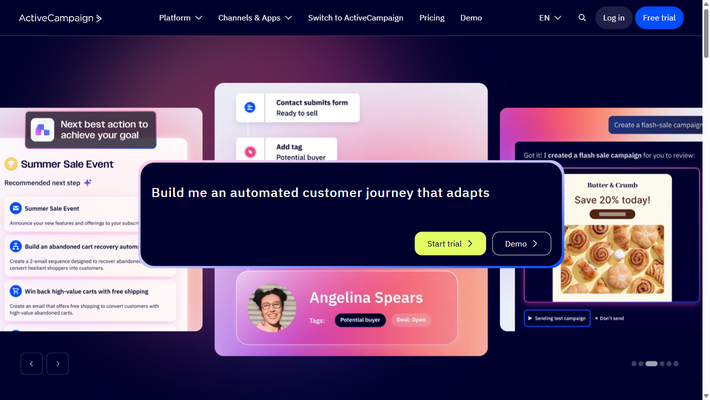
ActiveCampaign is the automation heavyweight: customer journeys, lead scoring, and a CRM in the same product. It carries 4.4 stars across 14,000+ G2 reviews, by far the largest review base on this page.
What makes ActiveCampaign a great Mailchimp alternative?
Automation is the whole product, not a feature. From the Plus plan up you get unlimited automation actions, where Mailchimp caps Essentials at four flow steps and even its Standard plan at 200 total flows. Conditional content, predictive sending, and premium CRM integrations turn one list into genuinely different journeys per subscriber, and the company backs new accounts with a 30-day money-back guarantee.
Top ActiveCampaign features
- Unlimited automation actions from the Plus plan up (Starter allows 5 per automation)
- Predictive sending and conditional content on the Pro plan
- Premium CRM and ecommerce integrations on Pro and Enterprise
- Dedicated Email + WhatsApp plan line for WhatsApp campaigns
- Email send allowance scales from 10x contacts (Starter) to 15x (Enterprise)
- 30-day money-back guarantee, free contact migration, chat and ticket support on all plans
ActiveCampaign cons
- No free plan, only a 14-day trial
- The Starter plan is tight: 5 actions per automation, limited segmentation, 1 user seat
- At 1,000 contacts the Plus plan runs $49 a month, three to five times the budget picks, and custom reporting is an add-on below Enterprise
Pricing
Trial: 14 days, no credit card
Billing: monthly or annual (annual shown below)
At 1,000 contacts: Starter $15/month, Plus $49/month, Pro $79/month, Enterprise $145/month
SMS and WhatsApp available as add-ons or dedicated plans; see current pricing for other contact tiers.
Klaviyo
Klaviyo is what Shopify stores graduate to when Mailchimp's ecommerce reporting stops being enough. It's rated 4.6 stars from 1,300+ G2 reviews.
When your store outgrows Mailchimp
Klaviyo's segments run on live store data: what someone bought, browsed, abandoned, and spent. Flows trigger off that behavior, and every campaign reports the revenue it produced, not just opens and clicks. If you're not running a store, though, that machinery is wasted weight; for audience businesses, Kit's own Mailchimp comparison is the more relevant read.
Top Klaviyo features
- Segmentation and automation driven by purchase and browsing behavior
- Revenue attribution built into campaign and flow reporting
- Email, SMS, WhatsApp, and push from one platform, billed by usage credits
- Free plan includes 250 profiles, 500 emails a month, and 150 SMS credits
- Built-in reporting, dashboards, and a customer self-service hub
Klaviyo cons
- Priced by active profiles, and it climbs fast: $45 a month already at 1,001–1,500 profiles
- Email support on the free plan lasts only the first 60 days
- Overkill without a store: the features that justify the price all need store data
Pricing
Trial: free plan, no expiry
Billing: monthly, priced by active profile count
Free: 250 profiles, 500 emails/month, 150 SMS credits
Email plan: $45/month at 1,001–1,500 profiles (15,000 sends)
Other profile tiers and SMS bundles: see current pricing.
Omnisend
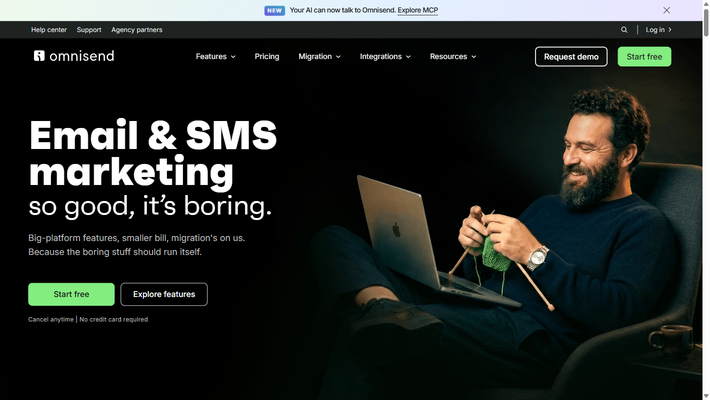
Omnisend is ecommerce email for stores that looked at Klaviyo's invoice and closed the tab. It matches the leaders at 4.6 stars on G2 across roughly 850 reviews.
What makes Omnisend a great Mailchimp alternative?
Every plan, free included, ships the store workflows Mailchimp spreads across paid tiers: cart abandonment, order and shipping confirmations, and welcome series come pre-built, and the automation editor isn't held back for upgrades. Support is 24/7 on every plan, which none of the budget competitors matches.
Top Omnisend features
- Pre-built ecommerce workflows (cart abandonment, order confirmation, welcome series) on all plans
- SMS available from every plan, paying per message; web push included
- Landing pages and signup forms on all plans, plus Facebook Custom Audiences and Google Customer Match syncing
- 24/7 email and chat support on every plan, free included
- Advanced reporting and an AI product recommender on the Pro plan
Omnisend cons
- Templates and workflows assume you sell products; it's a weak fit for a pure newsletter
- Advanced reporting needs the Pro plan
- The free plan caps at 250 contacts and 500 emails a month
Pricing
Trial: free plan, no expiry
Billing: monthly, priced by contact count
Free: 250 contacts, 500 emails/month
Standard: $16/month at 500 contacts, $20/month at 501–1,000 contacts (list prices, billed monthly)
Pro: $59/month at 500 contacts, or $41.30 with the current 30% discount; the 30% off applies when you pay 3 months upfront, then normal monthly billing resumes
SMS from $0.007 per message on any plan
Current rates: Omnisend pricing.
GetResponse
GetResponse bundles email with webinars and online courses, which no one else on this list attempts. It sits at 4.3 stars on G2 from about 700 reviews.
When GetResponse is all you need
If your funnel is webinar, then email sequence, then course sale, GetResponse replaces three subscriptions. The Creator plan hosts webinars for up to 100 attendees, sells courses to as many as 40,000 students with 0% transaction fees, and runs premium newsletters, all beside a full email marketing feature set. That consolidation is the pitch. Judged purely as an email tool, the cheaper picks above beat it.
Top GetResponse features
- Webinars for up to 100 attendees on the Creator plan (1,000 on Enterprise)
- Course creator with 0% transaction fees and premium newsletters on Creator
- Abandoned cart recovery, promo codes, and sales funnels from the Marketer plan
- Unlimited web push notifications from Marketer up
- AI content generators (limited to 3 uses on Starter, unlimited from Marketer)
- Landing page builder on all plans
GetResponse cons
- No permanent free plan, only a 14-day trial
- The Starter plan allows a single automation workflow
- Webinars and courses need Creator ($69 a month), and SMS is restricted to the Enterprise plan
Pricing
Trial: 14 days, no credit card
Billing: monthly or annual (annual saves 18%)
At 1,000 contacts: Starter $19/month ($15.58 annual), Marketer $59/month ($48.38 annual), Creator $69/month ($56.58 annual)
Enterprise: custom pricing.
Moosend
Moosend is the least glamorous tool here and the cheapest serious one. Users rate it 4.6 stars on G2 across about 740 reviews, most praising exactly what you'd hope: price and ease of use.
The cheapest way out of Mailchimp
Nine dollars a month at 500 contacts, or $7 on annual billing, buys unlimited email sends, the automation workflow builder, landing pages, forms, and an SMTP server. There is no cut-down entry tier hiding the good features on a higher plan; the Pro plan is the plan. The trade-off is a shorter feature list overall, and you get 30 days to test that trade-off for free.
Top Moosend features
- Unlimited email campaigns and sends on the Pro plan
- Automation workflow builder with pre-built recipes
- Landing pages and subscription forms included
- Custom-coded templates and an SMTP server on Pro
- 30-day free trial, no credit card, and biannual billing at 15% off if annual feels long
Moosend cons
- No permanent free plan; the 30-day trial limits you to 1 published automation and unpublished pages and forms
- Transactional emails are a paid add-on until the Moosend+ and Enterprise tiers
- No SMS or WhatsApp channel at any tier
Pricing
Trial: 30 days, no credit card
Billing: monthly, biannual (save 15%), or annual (save 20%)
Pro: $9/month at 500 contacts, $7/month on annual billing; scales with contact count
Moosend+ and Enterprise: custom, add transactional email, SSO, and an account manager.
Bonus: beehiiv
beehiiv stays out of the comparison table because it isn't a general email marketing tool: it's a newsletter publishing platform, and scoring it on store workflows or CRM checkboxes would be unfair in both directions. Its G2 listing is thin, 4.5 stars from about 40 reviews, so treat that rating as a small sample.
Why newsletter writers pick beehiiv
When the newsletter is the whole business, beehiiv's economics are hard to argue with. The free Launch plan covers 2,500 subscribers, and paid plans take 0% of your paid subscription revenue. Growth tooling is the other draw: a referral program, cross-promotion Boosts, and an ad network live in the product from the Scale plan up.
Top beehiiv features
- Free Launch plan for up to 2,500 subscribers
- 0% platform cut of paid subscription revenue on paid plans
- Referral program, Boosts cross-promotion, and ad network from the Scale plan
- Automations from the Scale plan up
beehiiv cons
- Automations, referrals, and monetization tooling all need Scale ($43 a month)
- Newsletter-only: no store workflows, no SMS, no CRM
- Small third-party review footprint (around 40 G2 reviews), so independent signal is limited
Pricing
Trial: free Launch plan, no expiry
Billing: monthly or annual
Launch: free, up to 2,500 subscribers
Scale: $43/month or $517/year, up to 100,000 subscribers
Max: $96/month or $1,151/year
Enterprise: custom, for 100K+ subscribers.
Frequently asked questions
What is the best free Mailchimp alternative?
Kit has the strongest free plan for most senders: 1,000 subscribers with unlimited sends, landing pages, and the ability to sell digital products. Mailchimp's free plan stops at 250 contacts and 500 emails a month. If your list is bigger than 1,000, Brevo's free plan publishes no contact cap, but limits you to 300 emails a day.
What is the cheapest Mailchimp alternative?
Moosend and Brevo. Moosend's Pro plan costs $9 a month for 500 contacts with unlimited emails, dropping to $7 a month on annual billing. Brevo's Starter plan is $9 a month for 5,000 emails. MailerLite is close behind at $12 a month for 500 subscribers.
Is Kit better than Mailchimp for creators?
For an audience business, yes. Kit's free plan covers four times more subscribers (1,000 against Mailchimp's 250), paid newsletters and digital product sales work on every plan, and the Creator Network grows your list through recommendations from other newsletters. Mailchimp still has the bigger template library and suits retail promo calendars better.
Why are people switching away from Mailchimp?
Three limits come up again and again: the free plan now covers only 250 contacts and 500 sends a month, automations on the Essentials plan stop at four flow steps, and paid plans cap monthly sends at 10 to 15 times your contact count. Once a list grows, those caps turn into upgrade pressure. Mailchimp's help center also confirms unsubscribed contacts count toward your billable total, so you pay for people you can no longer email.
What is the best Mailchimp alternative for ecommerce?
Klaviyo, if the budget allows. Its segmentation and automations run on live store data, and it reports revenue per campaign. At $45 a month for 1,001 to 1,500 profiles it costs real money, though; Omnisend covers the same core store workflows for less and includes 24/7 support on every plan.
What is the best Mailchimp alternative for a paid newsletter?
Kit or beehiiv. Kit lets you charge for a newsletter on any plan, including the free one, and adds a sponsorship marketplace once you want ad revenue. beehiiv's Scale plan ($43 a month) takes no cut of your subscription revenue, which beats most platforms once paid subscribers stack up.
Is Constant Contact a good Mailchimp alternative?
It solves few of the reasons people leave. There is no free plan, only a 30-day trial, and the Lite plan starts at $12 a month on US pricing. Every pick in the table above except ActiveCampaign, GetResponse, and Moosend has a permanent free plan, and most cost less at typical list sizes.
What's the best Mailchimp alternative for you?
Match the tool to your actual bottleneck:
| Your bottleneck | Pick |
|---|---|
| You earn (or want to earn) directly from your audience | Kit |
| You want the lowest bill that still does everything | MailerLite |
| Huge contact list, low sending volume | Brevo |
| Automation journeys plus a sales CRM | ActiveCampaign |
| A store with revenue worth optimizing | Klaviyo |
| A store on a startup budget | Omnisend |
| Webinars or courses in the same funnel | GetResponse |
| Unlimited sends for under $10 | Moosend |
| The newsletter is the whole business | beehiiv |
Our overall pick is Kit: the free plan is four times the size of Mailchimp's, and it's the only tool here where growing, sending, and earning from a list all live in one product.
See how Kit compares Prices on this page verified July 2026
Free trials exist for nearly all of these. Testing two of them side by side for a week will tell you more than any comparison table.
Sources & update history
All pricing and feature data on this page was accessed from these vendor pages on 11 and 12 July 2026:
- Kit pricing
- MailerLite pricing (and its features page)
- Brevo pricing (USD setting)
- ActiveCampaign pricing (USD setting)
- Klaviyo pricing
- Omnisend pricing
- GetResponse pricing
- Moosend pricing
- beehiiv pricing
- Mailchimp pricing (shown to us in local currency; limits quoted, prices linked)
- Constant Contact pricing
- HubSpot Marketing pricing
- Mailchimp contact types help doc
Update history: 11 July 2026: first published, all prices verified. 12 July 2026: prices re-verified, cost-at-scale table, migration guide, and Constant Contact and HubSpot coverage added; Brevo contact-allowance details corrected.